Most central ACs in Texas last between 10 and 14 years — about 3 years shorter than the national average. Here’s what kills Plano systems early, and what you can do to push yours past the average.
The national figure most homeowners hear — “AC lasts 15 to 20 years” — is roughly true. It’s just not true in Texas. Industry consensus from the U.S. Department of Energy, AHRI shipment data, and OEM lifespan documentation from Carrier, Lennox, and Amana puts a properly-installed residential central AC at 12 to 17 years. In Plano, real-world averages skew shorter because our cooling season runs longer, hailstorms hit condensers, and undersized or neglected systems run 18+ hours a day in July.
Below: what shortens Plano AC lifespan, what extends it (the 4.6-year tune-up delta is the headline), what the brand difference really amounts to, and the five signals that say “start planning replacement now.”
Call (972) 673-0408 for a free, no-obligation, no-pressure quote — 7 days a week.
The Honest Baseline: 12–17 Years (Industry), 10–14 Years (Plano)
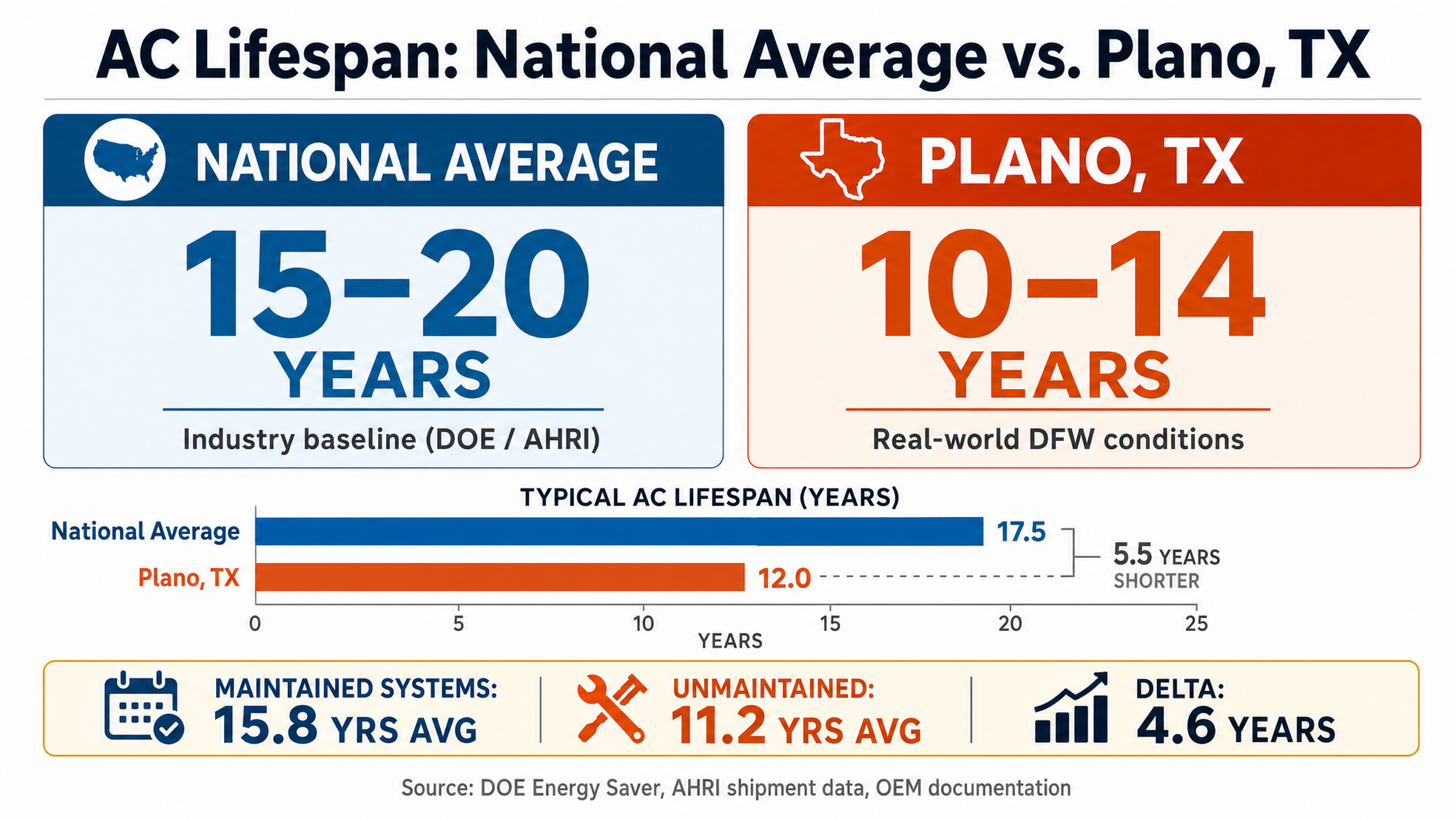
The U.S. Department of Energy’s Energy Saver guidance on central air conditioners puts modern systems at “15 to 20 years” of service life when properly maintained. AHRI shipment data — which tracks the actual replacement cycle in residential equipment — aligns closer to a 12-to-17-year practical average once you exclude systems scrapped early from neglect.
OEM-published claims sit in the same range. Carrier, Lennox, and Trane all publish 15–20 years. Amana publishes 12–18 years depending on tonnage class and climate. None of the major OEMs claim a single number — they all publish a range, because the variance is real.
Now apply Texas. Plano’s cooling season runs roughly March 15 through October 15 — about 7 months. A compressor in a North Texas home logs 1.5 to 2 times the runtime hours of the same compressor in, say, Pittsburgh. That alone shaves years off the high end of the industry range. Layer on hail exposure (Plano averages 3–5 significant hail events per year per NOAA Storm Prediction Center records), and the real-world Plano average lands at 10 to 14 years for systems that don’t get the maintenance discipline below.
That’s not a defect in your system. That’s Texas.
What Kills Plano Systems Early
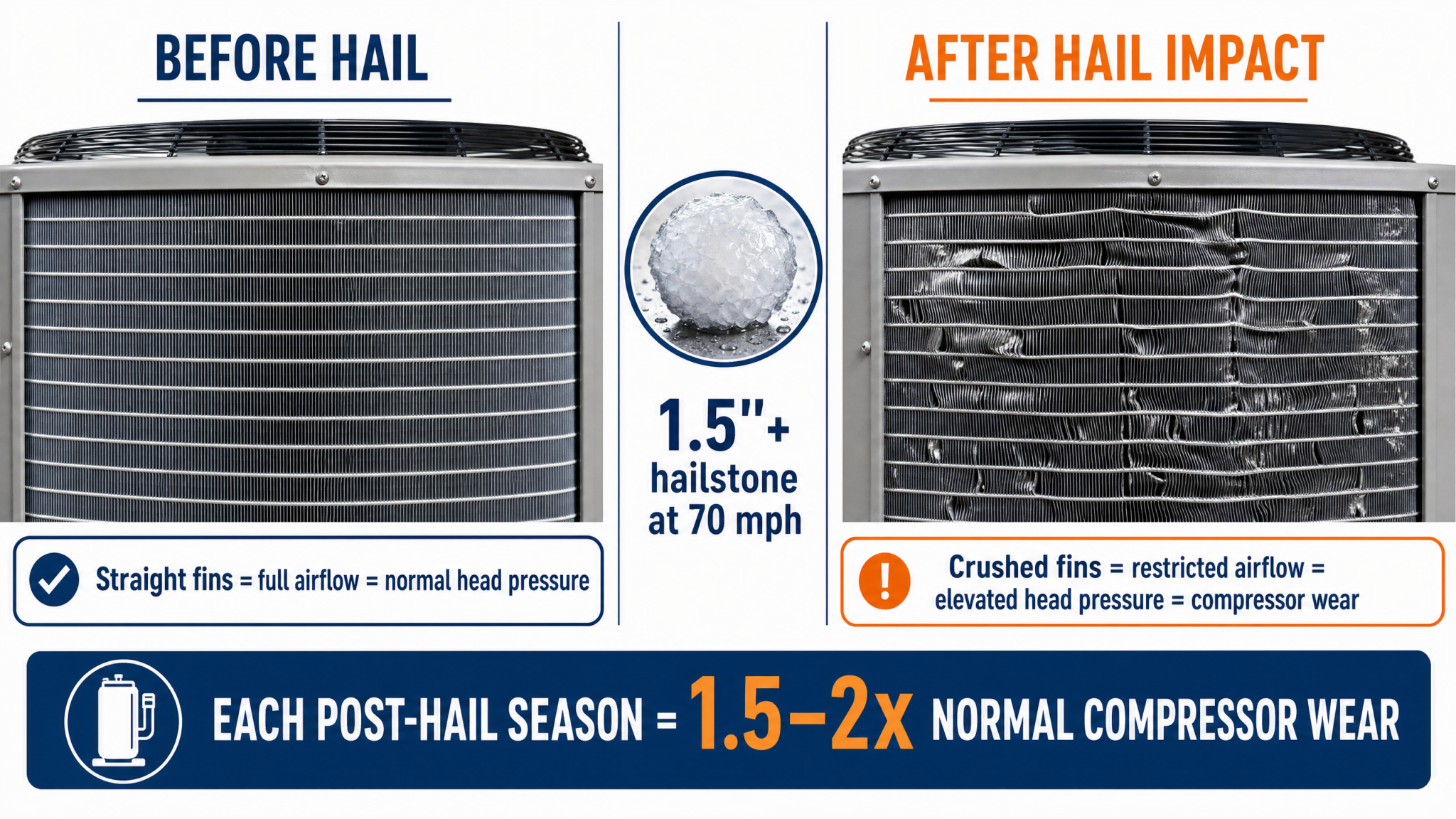
1. Hail Damage to the Condenser Coil
A 1.5-inch hailstone hitting your condenser at 70 mph crushes coil fins. The unit may still run — it just runs hotter, longer, against higher head pressure. Every summer of that mode is roughly 1.5 to 2 calendar years of compressor life burned. Hail fin combs straighten cosmetic damage; deep impact damage doesn’t comb out.
2. Undersized Systems Running 18+ Hours a Day
An AC that can’t keep up runs continuously on 100°F days. Most undersized Plano systems we see were sized by square-footage rule of thumb instead of a Manual J load calculation. The fix isn’t a bigger unit if the duct system can’t carry the air — the fix is a real load calc done right the second time.
3. Refrigerant Leaks Ignored for 2+ Summers
A sealed system doesn’t use refrigerant — it cycles the same charge for the life of the unit. “Low refrigerant” means you have a leak. A small leak ignored runs the compressor against an increasingly under-charged system, which means the compressor overheats internally on every cooling call. Most compressor failures we see in 8-to-10-year-old systems trace back to a leak that was symptomatic two summers earlier and never tracked down.
4. Dirty Coils That Never Get Cleaned
Per DOE guidance, dirty coils can reduce cooling efficiency by 30% or more. Outdoor coils in Plano need a chemical clean roughly every 2 years — cottonwood and live-oak pollen are aggressive on fins.
5. Oversized Systems That Short-Cycle
An oversized 5-ton system in a 1,800 sq ft West Plano home short-cycles year-round and rarely makes it past 9 years. Every “on/off” cycle is a compressor start — and starts are 4 to 6 times the wear of steady-state running. Oversized is as bad as undersized. Manual J catches both.
What Extends Lifespan (The 4.6-Year Tune-Up Delta)
The single biggest non-installation driver of AC lifespan is maintenance discipline. Industry data tracked by AHRI and the major OEMs converges on this:
| Maintenance Level | Average Lifespan |
|---|---|
| Two professional tune-ups per year | 15.8 years |
| No scheduled maintenance | 11.2 years |
| Delta | 4.6 years |
That’s a 4.6-year delta for $200–$400/year of preventive service. In replacement-cost terms, on a typical Plano install (~$9,500), that maintenance discipline is worth roughly $3,000–$4,000 of deferred replacement.
Want us to run a real lifespan-condition check on your specific system? Call (972) 673-0408 — free quote, no pressure, no obligation. 7 days a week.
The 5 Replace-Prediction Signals
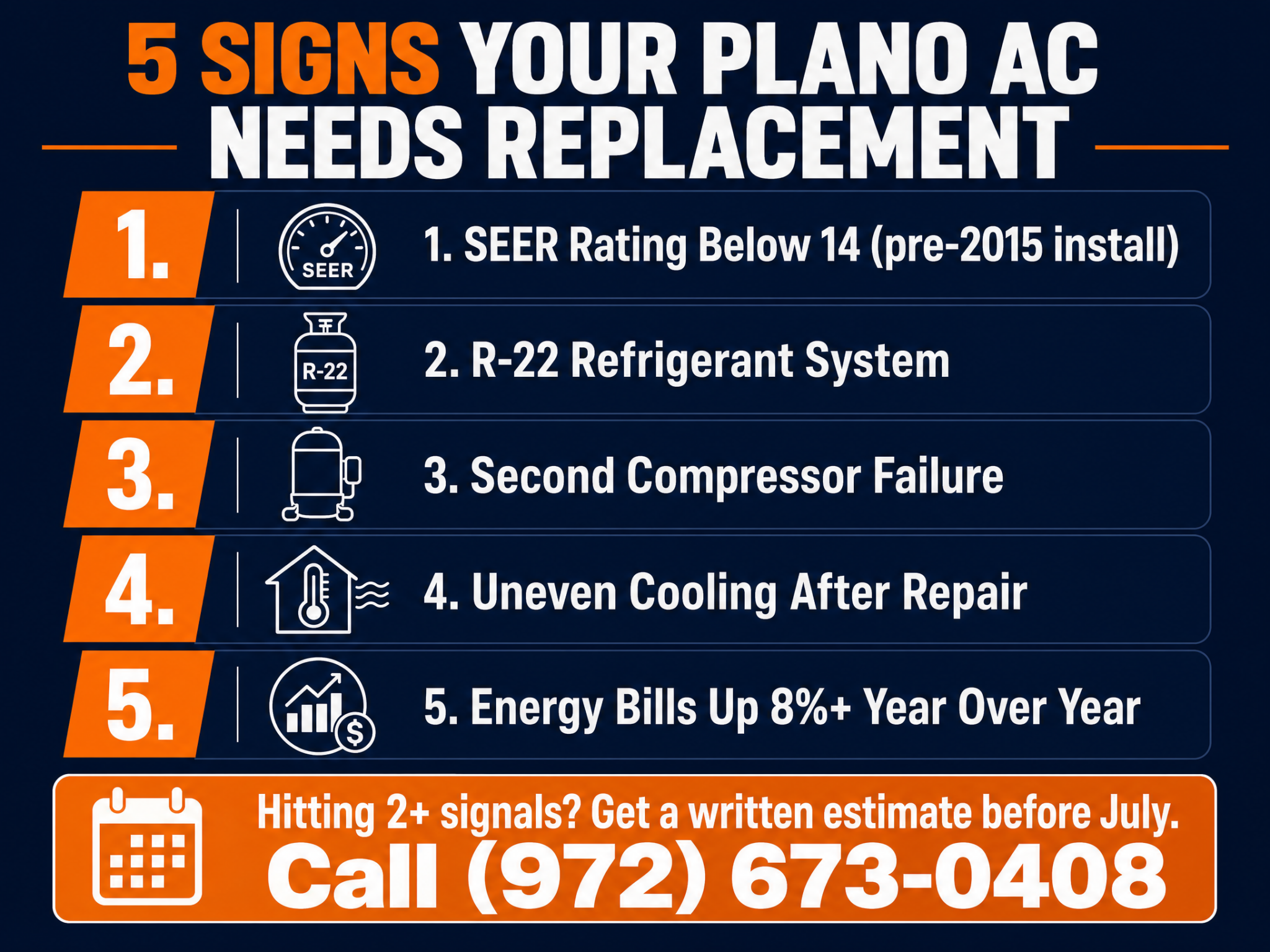
In our service experience, these are the signals that say “start planning replacement in the next 6–18 months”: SEER rating below 14 (pre-2015 install), R-22 refrigerant, second compressor failure, uneven cooling that persists post-repair, and energy bills creeping 8%+ year over year. Hitting one signal: tune-up and reassess. Hitting two or more: get a written replacement estimate so you’re not making the decision under emergency pressure in July.
Interactive Tools: Check Your System Right Now
Use the three tools below to decode your serial number, calculate your lifespan score, and get a replace-or-ride verdict — all based on real Plano conditions.
AC Serial Number Age Decoder
Find your manufacture year, SEER estimate & refrigerant type in seconds
Find the metal nameplate on your outdoor condenser. Enter the serial number below — the first 4–6 characters are what matter.
Tip: take a phone photo of the nameplate — you can read it later without going back outside.
Plano AC Lifespan Score Calculator
See where your system lands on the 10–14 year Plano range
Replace-or-Ride Decision Tool
Check the signals that say “start planning replacement now”
Check every statement that applies to your current system.
Get the Honest Assessment — In Writing
Randy and Teresa’s team will decode your nameplate, run the real condition check, and give you a written lifespan estimate. No pressure, no upsell theater.
📞 Call (972) 673-0408 — Free QuoteAvailable 7 days a week · Plano & Collin County · First-time web customers: $50 service call (half off)
FAQ: AC Lifespan in Plano, TX
What is the average lifespan of an AC in Plano specifically?
10 to 14 years in real-world Plano service, against the 12-to-17-year industry average — about 3 years shorter than the national figure. The shortfall comes from a longer cooling season (roughly 7 months), hail exposure (3–5 significant Plano events per year), and the local prevalence of undersized or short-cycling oversized systems. The most actionable number: maintained Plano systems average 15.8 years; unmaintained systems average 11.2 years. That 4.6-year delta is bigger than any brand, install year, or refrigerant-type difference.
Does brand matter for AC lifespan?
Marginally. OEM-published lifespan ranges for Carrier, Lennox, Trane, Amana, and Daikin all cluster at 12–20 years — variance of 1–2 years on average between brands. Install quality and maintenance discipline matter roughly 5 to 10 times more than brand choice within the same tier. A well-installed Amana with twice-yearly tune-ups will outlast a poorly-installed Lennox almost every time.
Is it cheaper to replace a 13-year-old AC now or run it 2 more years?
Run the math, don’t guess. A pre-2015 13 SEER system vs. a current 15.2 SEER2 system uses roughly 15–20% more electricity for the same cooling. On a typical Plano summer electric bill of ~$280/month for 5 months, that’s $210–$280 extra per cooling season. Over 2 more summers, the efficiency gap costs you $420–$560. Compare that to the decision triggers: annual repair costs rising 25%+ year over year, any R-22 refrigerant, or any second compressor failure. Hitting none of those = ride 2 more years. Hitting one = get a written estimate now. Hitting two = replace this spring.
What to Do Next
If your system is under 10 years old and getting tune-ups, you’re in the long-life category — keep doing what you’re doing.
If your system is 10 to 14 years old, this is the planning window. Get the next tune-up scheduled, get the condition honestly assessed, and know the replacement number before a July compressor failure forces the decision under pressure.
If your system is 14+ years old, R-22, or showing two or more of the five replace signals, here’s the simplest path forward: Call (972) 673-0408. A real person answers 7 days a week. We’ll come out, decode your nameplate, give you the honest remaining-lifespan estimate in writing, and — only if it’s actually time — put replacement options on the table with current 2026 financing and the federal 25C tax credit math already worked out.
$0 to know whether your system has 2 more good years or 12. Free in-home assessment, no obligation, no pressure.
— Randy & Teresa, and the team at 1st Class Heat & Air, Inc.
Call (972) 673-0408 · Get a Written Estimate → · Learn about Comfort Club →